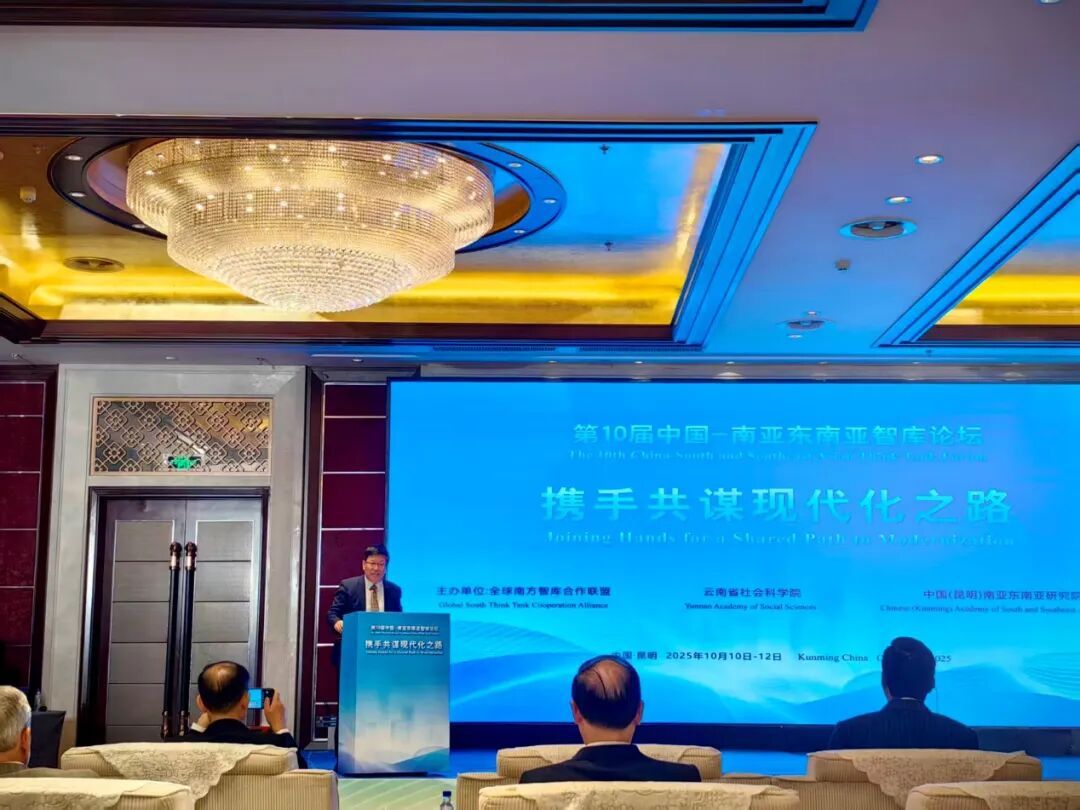
On October 11, 2025, the 10th China-South Asia & Southeast Asia Think Tank Forum was grandly convened in Kunming, Yunnan Province. Themed “Joining Hands to Explore the Path to Modernization,” the forum saw the invited participation of Professor Dai Yonghong, Dean of the College of International Studies Shenzhen University and the Institute of Area Studies and International Communication at Shenzhen University. He delivered a thematic presentation and a concluding speech during a sub-forum and the closing ceremony.
The forum was jointly hosted by the China Center for Contemporary World Studies under the International Department of the CPC Central Committee, the Global South Think Tank Network, the Yunnan Academy of Social Sciences, and the China (Kunming) Academy of South Asia & Southeast Asia. Representatives from institutions including the International Department of the CPC Central Committee, the Office of Spiritual Civilization Development of the CPC Yunnan Provincial Committee, the Sri Lanka-China Social and Cultural Cooperation Association, and the Cambodia-China Relationship Development Institute attended the event. Nearly 200 experts and scholars from 17 countries engaged in in-depth discussions on topics such as the “Global Development Initiative and the Path to Modernization,” the “Global Civilization Initiative and Civilizational Exchange and Mutual Learning,” and “Digital Economy and Security Cooperation.” Participants generally agreed that strengthening think tank cooperation is a crucial engine for promoting regional common development and achieving mutual benefit and win-win outcomes. It will provide sustained momentum for regional peace, stability, and prosperity, and offer solid intellectual support for implementing the Global Development Initiative, Global Security Initiative, Global Civilization Initiative, and Global Governance Initiative.
At the second sub-forum, titled “Global Civilization Initiative and Civilizational Exchange and Mutual Learning,” Professor Dai Yonghong delivered a keynote speech titled “Cognitive Shaping and Communication Strategies of the Three Global Initiatives in BRICS Countries.” He was also invited to deliver a summary of the second sub-forum during the closing ceremony.
Professor Dai pointed out that the Global Civilization Initiative is an important public good proposed by China to address global challenges and promote common human development. Rooted in the philosophical wisdom of Chinese civilization, such as “harmony in diversity” and “universal harmony,” it serves as a positive response to and transcendence of outdated Western notions like the “clash of civilizations” and “civilizational superiority.” The core of this initiative lies in equality and respect, emphasizing that all civilizations, regardless of their history or a nation's power, are treasures of humanity, possessing equal value and dignity. This stance breaks the long-standing Western-centric narrative, securing due status for non-Western civilizations in the global discourse and helping to build a just and pluralistic new international cultural order.
He further noted that “civilizational exchange and mutual learning” is the practical path to realizing this vision. The progress of civilization stems from exchange, while isolation leads to stagnation. From the ancient Silk Road to contemporary cyberspace, the history of human civilization is a history of exchange and mutual learning. Mutual learning does not mean assimilation but achieving common growth and innovation through mutual appreciation and reference.
Professor Dai Yonghong believes that the proposal of the Global Civilization Initiative and civilizational exchange and mutual learning holds triple profound significance:
First, it addresses the trust deficit. Against the backdrop of counter-globalization currents and geopolitical tensions, the initiative provides an ideological foundation for enhancing mutual trust and understanding among different nations and peoples.
Second, it enlightens global governance. In the face of global challenges such as climate change and public health crises, civilizational mutual learning advocates drawing on diverse wisdoms, contributing inclusive and effective Chinese solutions to global governance.
Third, it consolidates the humanistic foundation for a community with a shared future for mankind. A community with a shared future is not only a political and economic concept but also a civilizational and cultural proposition. Only on the basis of cultural understanding and spiritual affinity can a profound social consensus for building a shared future be formed.
Finally, Professor Dai emphasized that the Global Civilization Initiative and civilizational exchange and mutual learning chart a course for human society toward pluralistic coexistence and common development. The future of humanity should not be an arena for civilizational confrontation but a garden where all civilizations flourish together. Although the path to realizing this vision is long and challenging, its direction aligns with the historical trend and the common interests of people worldwide, and it is destined to become a significant force in promoting the building of a world of lasting peace and universal prosperity.
First Reviewer: Li Tian
Second Reviewer: Fu Le
Third Reviewer: Dai Yonghong